
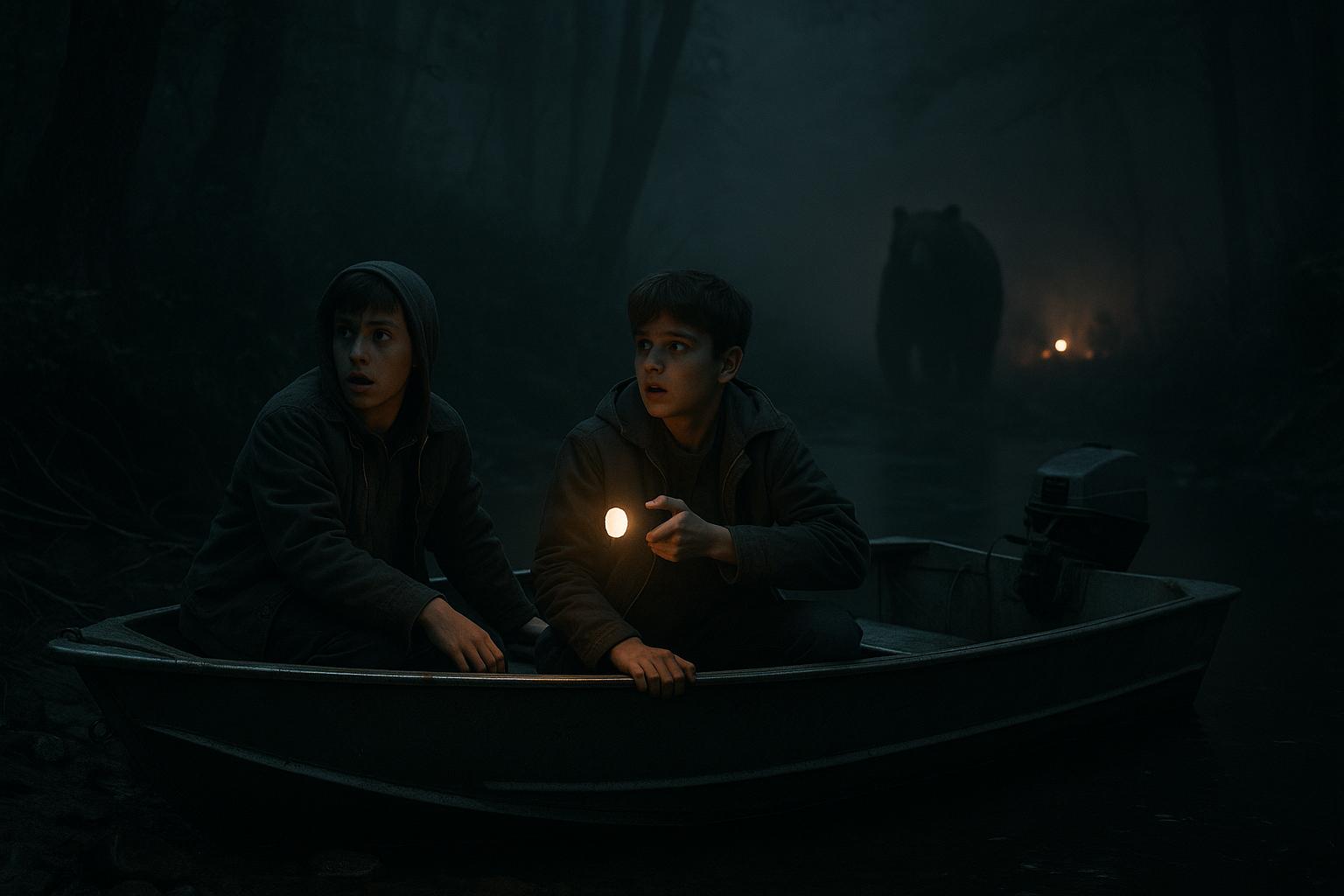
In 1970 I was thirteen, I was hungry for adventure — the kind that felt like freedom, danger, and discovery all rolled into one. When my friend Bobby Jones, who lived two blocks down the street, invited me to spend the weekend in the Poconos with his family, I nearly exploded with excitement. They had a small silver camper parked along the Delaware River — one of those gleaming aluminum ones people now call “vintage,” but back then, it was just a camper in the woods.
To me, though, it sounded like another planet. I’d never spent a night away from home without my family, and the idea of camping beside a rushing river made my heart race. But first, there was one challenge bigger than the Delaware itself: convincing my parents.
That night at dinner, I planned my pitch like a lawyer presenting his closing argument. “Bobby’s parents have a camper up by the Delaware,” I said casually, trying to sound responsible. “He asked if I could go this weekend.”
My father didn’t even look up from his plate. “No,” he said flatly. “We don’t know his parents.”
My mother glanced at him with that gentle look that meant she was already halfway convinced. “Oh, come on,” she said softly. “He’s thirteen, not three. What’s the harm?”
My father sighed — that long, heavy sigh I recognized as the sound of surrender. “Fine. But you call when you get there.”
I shot up from the table so fast my chair tipped backward. Minutes later, I was sprinting down the street to Bobby’s house shouting, “I can go!”
We arrived late Saturday morning. The air smelled like pine needles and campfire smoke, and the Delaware glimmered just beyond the trees — narrower here than the wide stretch near Philadelphia, but wilder too.
Bobby’s family set up chairs by the fire pit while we explored: a playground, a little game room, a pool, and best of all, a rickety dock with a handful of small aluminum boats tied to it. One of them had a tiny outboard motor — ancient, dented, but magical in our eyes.
By late afternoon, the sun turned the river gold, and Bobby grinned. “You know, there’s a pizza shack about a mile downstream,” he said. “We could take the boat, grab a couple slices, and be back before dark.”
It sounded perfect. Two kids, a river, and freedom.
We untied the boat, started the motor, and eased into the current. The sound of the engine was a happy buzz, the smell of gasoline sharp in the cool air. The river carried us easily — like it approved of our adventure. We passed towering cliffs, fallen trees, and the reflection of night hawks gliding overhead. For a while, it felt like we were explorers on some grand expedition.
When we reached the pizza place — little more than a crooked sign and a wooden dock — we felt like kings. We ate, laughed, and watched the sky deepen into soft pinks and purples. By the time we pushed off again, the air had turned cooler, the first hints of night whispering through the woods.
We headed home . A few bends upstream, the motor sputtered — a sharp cough, then silence.
“Try it again,” Bobby said.
I yanked the cord. Nothing. Just the hum of crickets and the soft slap of water against aluminum. I tried again, and again. Still nothing.
We looked at each other. The current had already caught us, dragging the boat backward.
There were no oars in the boat — just an empty bracket where one might have been. We both realized at the same time what that meant. We were completely at the mercy of the river.
“Maybe we can drift close to shore,” I said, but my voice didn’t sound steady.
The river didn’t care. It was pulling harder now, the current twisting us sideways, spinning us like a tin toy. After passing the pizza place the shoreline disappeared behind a veil of darkness.
When the last light faded, it was as though someone had snuffed out the world. No stars. No moon. Just the steady pull of black water and the sound of something — branches, or maybe not — scraping the side of the boat.
“Let’s get to shore,” I said finally, and we waited until we saw a break in the trees — a sliver of lighter darkness. We let the current push us toward it, scraping against rocks and reeds until the hull hit mud.
We jumped out, pulling the boat halfway up the bank, gasping with relief. The woods smelled damp and heavy. Then came a sound — low, deliberate footsteps behind us.
We turned. In the beam of the flashlight, two yellow eyes glinted. A bear.
It froze, just as startled as we were. Then, after a long moment, it turned and lumbered away into the forest. The silence that followed was somehow worse.
We decided to head for the road we knew ran parallel to the river, hoping we could walk back to camp. The woods were thick and uneven, and every branch seemed to claw at us. Somewhere in the distance, a dog barked — once, then stopped.
After what felt like forever, we saw a flicker of light — a fire, glowing faintly through the trees. Relief hit like a wave. “Someone’s out here,” I said. “We can get help.”
We stepped into a clearing and froze.
Two men sat by the fire. One was tall and wiry, his face lost beneath a tangle of greasy hair. The other, heavier, had bloodshot eyes and a cigarette dangling from his lip. Empty bottles littered the ground around them.
“Well, look what the river coughed up,” the tall one said, his grin twisted. “You two boys look lost.”
“Our motor died,” Bobby managed to say. “We just need to get back upriver.”
The heavy one laughed — a wet, broken laugh that made the hairs rise on my neck. He stood, swaying slightly, and pointed his beer bottle at us. “You know what happens to people who go down river at night?” he slurred. “They don’t come back.”
The tall one kicked a log into the fire, sending sparks flying. “Maybe we should give these boys a lesson in directions,” he said, stepping closer.
We backed away, the smell of sour whiskey and smoke closing in.
“Hey, don’t be rude now,” the heavy one said, suddenly grinning too wide. “We got marshmallows.” He mimed holding a stick, pretending to roast something, his eyes never leaving us. “You like marshmallows, right?”
He burst out laughing, and the other joined in — too loud, too sudden. Then the tall one hurled his bottle into the fire, shattering it, the flames leaping high for an instant.
That’s when we bolted .
Branches whipped our faces as we tore through the forest. Behind us, one of the men yelled something — a long, drawn-out call that sounded more animal than human.
Then came the sound of an engine — not theirs. Headlights cut through the dark, freezing us in place.
A voice shouted, “You boys lost?”
A park ranger type guy stepped out of a mud-splattered jeep, his flashlight scanning the woods. The men were gone, the firelight flickering faintly behind us. The ranger looked from us to the river, then back again.
“You shouldn’t be out here after dark,” he said calmly. “This stretch has a way of turning people around.”
The next morning, fog clung to the Delaware like a ghost that didn’t want to leave. The ranger had found our boat and towed it upriver. The little motor started on the first pull.
We stood there in the gray light, the surface of the river as smooth as glass.
“Hard to believe that’s the same river,” Bobby whispered.
The ranger smiled faintly. “That’s how she works,” he said. “Rowing harder doesn’t help if your boat’s headed in the wrong direction.”
We didn’t fully understand him then. But we both knew we’d just learned something about rivers, people — and fear — that would never quite leave us.
Discover more from Beebop's
Subscribe to get the latest posts sent to your email.

 Beebop's