
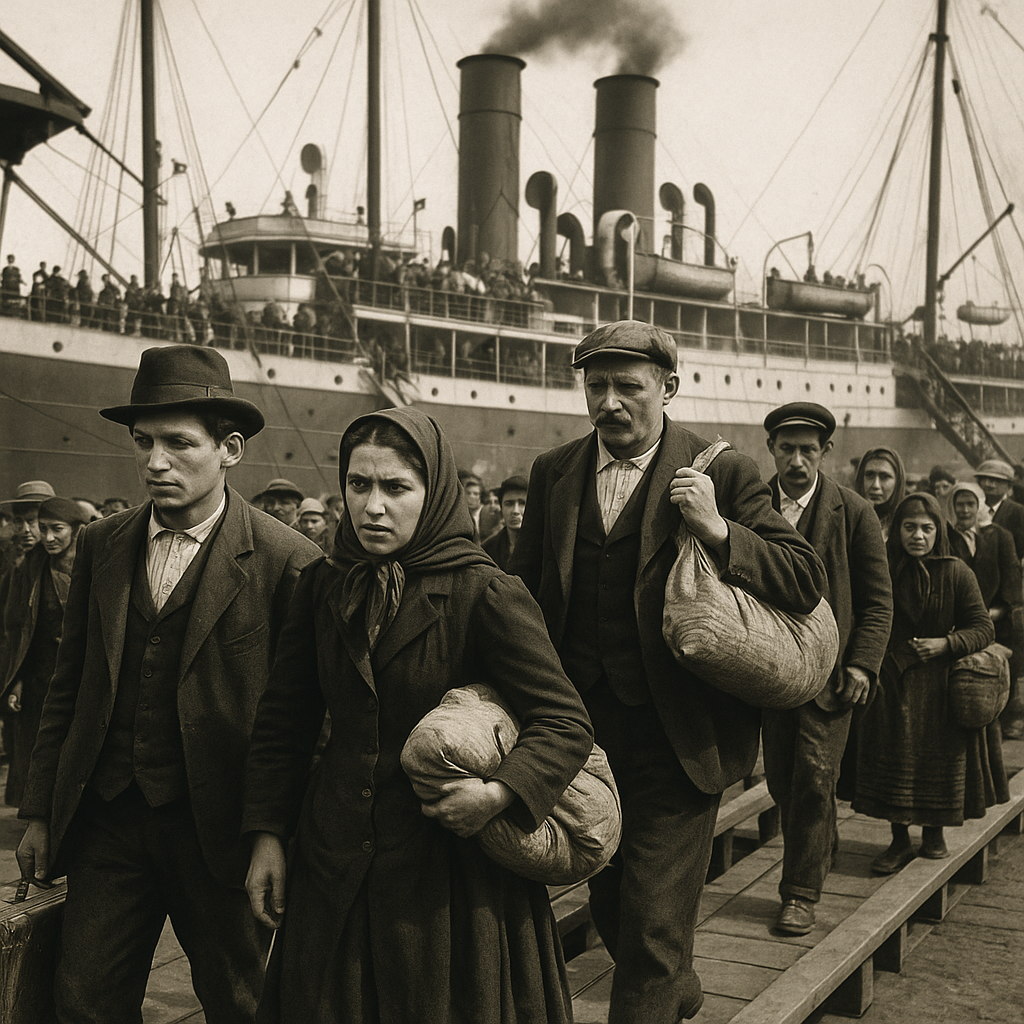
One thing I’ve learned is that discrimination isn’t unique to any one group — it’s something almost every minority faces somewhere in the world. For immigrants, it usually starts the moment they step onto new soil. Italians, Irish, Jews, Chinese, Mexicans — every group had a period where they were judged, pushed aside, or treated as “less than.” But it’s important to say this clearly: no group in America suffered more or for a longer period than Black Americans, who didn’t choose to immigrate here and were denied basic rights for generations. Their struggle was far deeper and lasted far longer than anything my family faced.
Still, in different ways, almost every group that arrives in a new country ends up fighting for acceptance. Italians were no different. Our journey into the American mainstream followed the same pattern of proving ourselves, working harder, and pushing through doors that didn’t easily open.
There’s another side to this story, though. Not everyone who came to America arrived as an immigrant. Some came as settlers — people who weren’t joining an existing society but building a new one where they wouldn’t face the discrimination or persecution they left behind. Settlers created the culture instead of trying to fit into it. Immigrants, on the other hand, enter a society that already has its rules, prejudices, and power structures. They have to earn acceptance in ways settlers never did. That’s why the immigrant experience — including the Italian one — comes with challenges and discrimination settlers simply never faced.
Every family carries stories that explain who they are. In mine, those stories go all the way back to a time when Italians weren’t welcomed with open arms. People today don’t realize how tough it really was. Most Americans have no idea that in the early 1900s, Italians were one of the most targeted immigrant groups in the country. Some were beaten, some were driven out, and in one of the darkest moments — New Orleans in 1891 — eleven Italians were lynched in what became the largest mass lynching in U.S. history. A few years later, in Tallulah, Louisiana, several more Italians were killed simply for being Italian.
Those wounds didn’t disappear. They lingered.
The Moment I Realized Prejudice Was Still Alive
I was blessed to grow up in a home where prejudice simply didn’t exist. My parents never showed an ounce of it — not toward race, religion, or anyone who lived differently. My father especially. He was a staunch Democrat, even considered liberal for his time — the kind of man who lived by the Golden Rule: “Do unto others as you would have them do unto you.”
Dad grew up in a mostly Italian enclave in West Philadelphia, where families lived close, worked hard, and took pride in who they were. But it wasn’t always easy. When he was a young boy, the Irish Catholic school near their neighborhood wouldn’t allow Italian boys to attend — not because of grades, behavior, or character, but simply because of their heritage. He never forgot that sting. It was one of the first times in his life he was told he didn’t “belong,” and it stayed with him forever.
My father didn’t let those experiences turn him bitter. If anything, they made him more compassionate. Some of my greatest life lessons came from him during our fishing trips. Between casts, he’d talk about fairness, human dignity, and how you treat people. He didn’t shy away from history either. He told me about World War II — about the Nazis, about the horrors inflicted on the Jewish people, and how hatred left unchecked can grow into something monstrous.
He also spoke often about the injustices faced by Native Americans — how they were pushed from their land, mistreated, and written out of the very history they helped shape. My father had a deep respect for them. He always said they were among the most misunderstood and unfairly treated groups in our country. He wanted me to understand how dangerous it becomes when people stop seeing the humanity in others, no matter who those “others” are.
And then there was the story that shook him the most. One day in the 1960s, the FBI showed up at his place of employment to question him. They wanted to make sure he wasn’t related to someone involved with the Philadelphia mob. Italians back then were often painted with one brush — criminals, gangsters, untrustworthy — even when they had lived their entire lives with honesty and dignity. My father was none of those things, but the stereotypes followed him anyway.
He came home upset that day. Not boiling mad — just deeply hurt that anyone would dare question his character simply because of his last name.
All of this shaped me.
But here’s the strange twist: despite everything he told me, I grew up in a completely different world.
I never heard a curse word in my house.
Not one.
And I never — not one single time — heard the N-word.
Not at home.
Not at school.
Not from my friends.
To me, people were people. Period.
As a kid in the suburbs of Philadelphia, I couldn’t understand why one group would ever mistreat another. It just didn’t make sense. So by the time I entered the workforce, I walked in with a kind of innocence — or maybe naïveté. I truly believed America had put all that behind us.
I soon learned it hadn’t.
A Comment I’ll Never Forget
It happened in the 1990s. I was well into my retail career, managing one of the discount stores I oversaw. I walked past a senior executive talking to another manager, and I heard him say:
“He’s a typical Italian.”
The tone told the whole story.
It was my first real wake-up call — my first real taste of the same thing my father had experienced decades earlier. I finally understood what he had tried to shield me from and prepare me for at the same time.
But even then, I didn’t let it shake me.
If anything, it strengthened my resolve.
And here’s life’s little twist of irony:
Years later, after I had worked my way up and eventually became a VP at the company that purchased my former company, that very same executive reached out to me. He needed my help getting one of his colleagues a job.
I wasn’t angry.
I wasn’t bitter.
But I’d be lying if I said I didn’t feel a quiet sense of satisfaction.
A reminder that hard work outlives stereotypes every single time.
Then It Happened Again — 2005
Fast-forward to 2005. I opened a store in a small town with a tight, old-guard community — families who had been there for generations and tended to keep business among themselves.
One afternoon, as I unloaded my truck, a local businessman — an older gentleman who ran a tax service — walked up and said:
“Why did you pick this town to open your store?”
I looked at him like he had three heads.
Then he spelled it out bluntly:
“The people here won’t shop in your store. They keep their business to themselves.”
Coming from the Philly suburbs, I had never heard anything like that. I told him, “I’ve been in the antique and retail business over 30 years — I’ll be fine.”
And I was.
I made great friends.
I built a loyal customer base.
And I stayed for 15 years.
But the old guy wasn’t completely wrong.
There was an old-town clique who never once set foot inside. I’d see them at auctions and flea markets — I knew they liked antiques — but when they walked past my storefront, they wouldn’t even make eye contact, even when I smiled and greeted them.
And you know what?
It didn’t bother me one bit.
Just like my father taught me, I refused to carry someone else’s small-mindedness.
When I eventually retired and closed the store, I walked away with no grudges — only gratitude for the many friendships I made both inside and outside that town.
Why All of This Gives Me Empathy Today
These experiences — my father’s, my family’s, and my own — completely shaped how I see the world.
I know what it feels like to be judged by your name, your accent, your heritage, or the neighborhood you’re from. I know what it’s like to walk into a room already labeled before you even speak. I know how unfair and discouraging it can be to do everything right and still be treated with suspicion.
So when I see hardworking immigrants today — people who come here legally, follow the rules, and just want the same fair chance my family wanted — I feel a special connection.
Because that used to be us.
My grandfather.
My father.
And even me.
The lesson I carry with me is simple:
You don’t judge people by where they come from — you judge them by how they live.
And Today… There’s a New Kind of Prejudice
The older I get, the more I realize prejudice never truly disappears — it just changes its disguise.
In my father’s day, Italians were judged for their names, their accents, their heritage.
In my day, I saw it in subtle comments and cold shoulders.
And today?
People get judged by their political affiliation.
A yard sign, a bumper sticker, one comment on social media — and suddenly people think they know everything about you.
Good or bad.
Right or wrong.
Friend or enemy.
It wasn’t like that when I entered the workforce.
Back then, nobody knew what political party you belonged to — and to be honest, nobody cared. You were judged by your work ethic, your attitude, and how you treated people, not by who you voted for.
Today it’s different.
We’ve simply traded last names and accents for red and blue labels.
But the lesson my father taught me on those fishing trips still holds true:
Judge people by how they treat others — not by the tribe society tries to lump them into.
If we forget that, we’re just repeating the same mistakes with new excuses.
Discover more from Beebop's
Subscribe to get the latest posts sent to your email.

 Beebop's