
With everything that is happening around the world today this question has been rattling around in my head lately, because the more I look at it, the more I realize the answer has less to do with history itself and more to do with where we choose to start the story. How will history remember our times 500 years from now?
Most people today hear the word Crusades and immediately think religious fanaticism, slaughter, intolerance, and blind violence. And to be clear right up front—there was plenty of brutality, plenty of innocent blood spilled, and plenty of actions that deserve condemnation. I’m not here to excuse any of that.
But here’s the part that rarely gets discussed: the Crusades did not begin in a vacuum.
For centuries before the first Crusade was ever called, large portions of the Christian world had been taken through invasion and conquest by powerful regional powers controlling the eastern Mediterranean. Territories across the Middle East, North Africa, and parts of Europe changed hands. By the late 11th century, the Byzantine Empire—a Christian empire that had existed for hundreds of years—was losing its core lands after a devastating defeat by the Seljuk Turks at Manzikert in 1071. Christian pilgrimage routes were disrupted, and Constantinople itself faced real danger.
That context matters.
The First Crusade was called after a direct plea for help from the Byzantine emperor to Western Europe. Whatever the Crusades later became, they began as a response to military losses and a genuine fear of further conquest.
So why, then, are the Crusades remembered today almost entirely as something evil?
Because history, more often than not, judges wars not by why they started, but by what happened once they were underway.
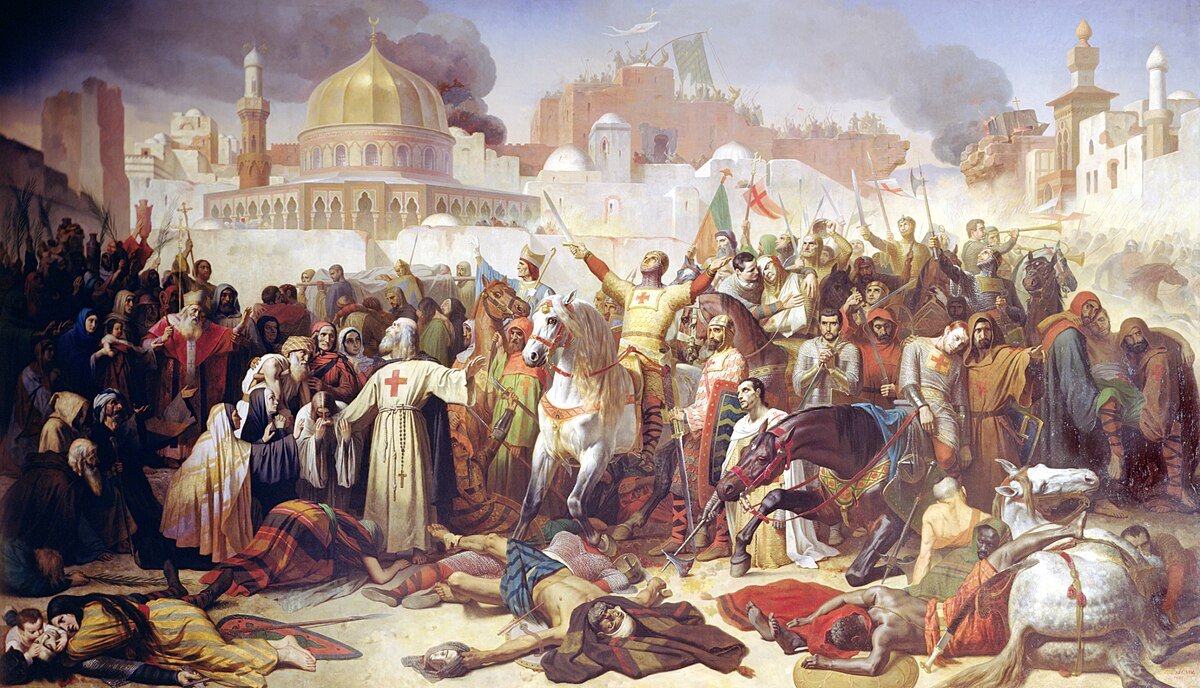
When Jerusalem fell in 1099, civilians—Muslims and Jews—were massacred. That event became the defining image of the Crusades. Once that image takes hold, background and chronology fade away. Defensive motives lose their weight the moment innocent people are slaughtered. No amount of historical context changes that reality.
Then things drifted even further.
Later Crusades moved far beyond defense. Power, wealth, politics, and personal ambition crept in. The breaking point for many historians came with the Fourth Crusade, when Crusaders didn’t fight opposing forces at all—they sacked Constantinople itself, a Christian city, crippling the very empire they were supposedly defending. At that moment, whatever moral footing the Crusades once had largely collapsed.
There’s another reason the Crusades are judged so harshly today, and it has to do with how stories are framed.
Imagine teaching World War II by starting the narrative with the atomic bombing of Hiroshima or the firebombing of Dresden. Ignore Hitler. Ignore the invasion of Poland. Ignore the Holocaust. Ignore Pearl Harbor. If the story begins there, the Allies look like monsters.
That doesn’t mean those bombings weren’t horrific. It means starting at the end distorts the truth.
The same thing happens with the Crusades. When the story begins in Jerusalem in 1099 instead of centuries earlier, the Crusades appear as unprovoked religious aggression rather than what they originally were: a response that spiraled out of control.
Modern audiences also struggle with wars fought openly in the name of religion. Secular empires conquered just as brutally, but religious language makes people deeply uncomfortable—and understandably so. Add to that a tendency to scrutinize Western history more harshly than others, and the Crusades become a simplified moral warning rather than a complicated historical event.
Here’s the uncomfortable truth that doesn’t fit neatly into slogans:
The cause of the Crusades was understandable in its historical context.
The conduct of the Crusades was often indefensible.
Both statements can be true at the same time.
History isn’t clean. It isn’t simple. And it doesn’t hand out moral clarity unless we’re willing to look at the entire timeline—not just the moments that shock us the most.
Which brings me to something far closer to our own time.
I can’t help but wonder how the Gaza Strip will be remembered a hundred years from now.
Will history remember years of terrorist attacks, rockets fired into Israel, suicide bombings, tunnels, and the deliberate targeting of civilians?
Will it remember October 7th—the murders, the kidnappings, the hostages taken, and the shock that rippled across the world?
Will it remember a nation responding to what it saw as an existential threat?
Or will the story begin somewhere else?
Will future generations start the timeline with images of destroyed neighborhoods, dead children, and a humanitarian catastrophe?
Will it be remembered primarily as a cruel and devastating attack on a civilian population by Israel?
I don’t pretend to know the answer. History rarely delivers clean verdicts. What I do know is this: where the story begins will shape who history condemns.
Just like the Crusades.
Just like World War II.
Context never erases suffering. But removing context almost always distorts responsibility.
And maybe this is the part of the story we never seem to learn.
The human story repeats itself over and over again because we keep dividing ourselves into tribes, religions, borders, and causes—forgetting the one thing that never changes. We are all earthlings. Humans. The same species, living on the same planet, sharing the same fragile future.
At the same time, I’m not naïve enough to believe that borders, nations, and sovereignty don’t matter. Until the day humanity truly sees itself as one people on one planet, sovereign borders play a necessary role in preserving order and preventing chaos. Borders don’t exist only to divide; they exist to define responsibility—laws, accountability, and security. A world without borders today wouldn’t be peaceful; it would be unstable. History shows that just as clearly as it shows the cost of war.
That tension has always existed. Borders can preserve peace, while rigid identities built around them can also fuel conflict. Both truths exist at the same time.
So perhaps the goal isn’t to erase borders, but to hold them with humility—to recognize that while nations are necessary, they are not sacred; while cultures matter, they are not superior; and while security is essential, it cannot come at the cost of forgetting our shared humanity.
Until we truly understand that we are all earthlings—the same species on the same planet—borders remain a tool. A guardrail. Not the destination.
And if history has taught us anything at all, it’s that peace doesn’t come from pretending differences don’t exist. It comes from managing them wisely, remembering that beneath every flag, every religion, and every border line, there are still just people—trying to live, protect their families, and make sense of a world that keeps testing us.
That balance, imperfect as it is, is probably the best we can do for now.
Discover more from Beebop's
Subscribe to get the latest posts sent to your email.

 Beebop's