

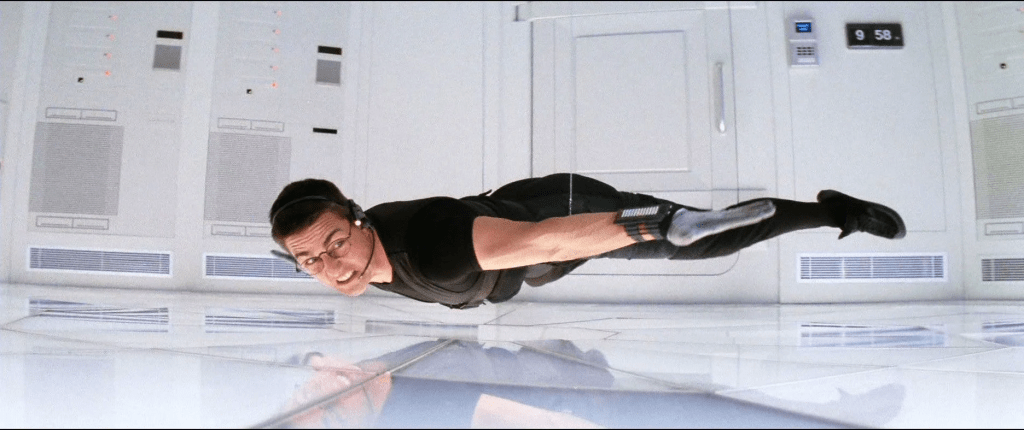
I was watching an old Mission: Impossible movie last night, one of the earlier ones starring Tom Cruise, and I caught myself doing something I don’t do very often anymore — I was genuinely amazed. Not just entertained, but amazed. I wasn’t only watching the story unfold, I was leaning forward thinking, How in the world did they do that?
A big part of that magic came from knowing that what I was seeing actually happened. Real stunts. Real risk. Real people hanging off planes, running across rooftops, crashing through glass. Tom Cruise became famous not just for the roles he played, but for the fact that he was willing to put his own body on the line to make the scene believable. That knowledge added tension. It added excitement. It added stakes.
The same thing happened years earlier when Jurassic Park first came out. Or when Star Wars hit theaters. Audiences weren’t just watching dinosaurs or spaceships — we were marveling at the craftsmanship behind them. Practical effects. Groundbreaking models. Revolutionary makeup. Entire teams of artists, builders, and technicians working behind the scenes to pull off something no one had seen before.
And that was part of the draw. The wonder wasn’t just what we were seeing, but how it was done.
That’s the part I think we’re about to lose.
Very soon, almost everything on screen will be created by AI. Stunts without danger. Explosions without heat. Faces without age. Voices without breath. Actors who passed away decades ago will “star” in new films, with their families collecting royalties from digital versions of their image and voice. Real human acting will slowly be replaced, and acting awards as we know them will simply disappear — because what exactly are we awarding anymore?
When anything is possible, nothing feels special.
If a computer can generate any scene, any performance, any impossible moment with the click of a button, the sense of discovery disappears. There’s no awe left when you know the answer to “How did they do that?” is always the same: a server farm somewhere rendered it in seconds, minutes, or hours.
We’re already drifting there. Movies feel bigger, louder, and more perfect than ever — and somehow less memorable. The imperfections are gone. The human limits are gone. The danger is gone. And with it goes the edge-of-your-seat feeling that kept audiences talking for weeks after leaving the theater.
Great films were once a collaboration between human imagination and human limitation. The tension between what artists dreamed up and what physics would allow is what made those moments electric. AI removes the struggle, and when you remove the struggle, you remove the soul.
I love technology. I use it every day. But when it comes to movies, I think we’re trading wonder for convenience. We’re gaining infinite possibilities and losing the very thing that made cinema magical in the first place.
Can you spell BORING?
Because once everything is effortless, once every stunt is fake and every performance is synthetic, sitting in a dark theater won’t feel like witnessing something incredible anymore.
It’ll just feel like watching a very expensive screensaver.
Discover more from Beebop's
Subscribe to get the latest posts sent to your email.

 Beebop's