
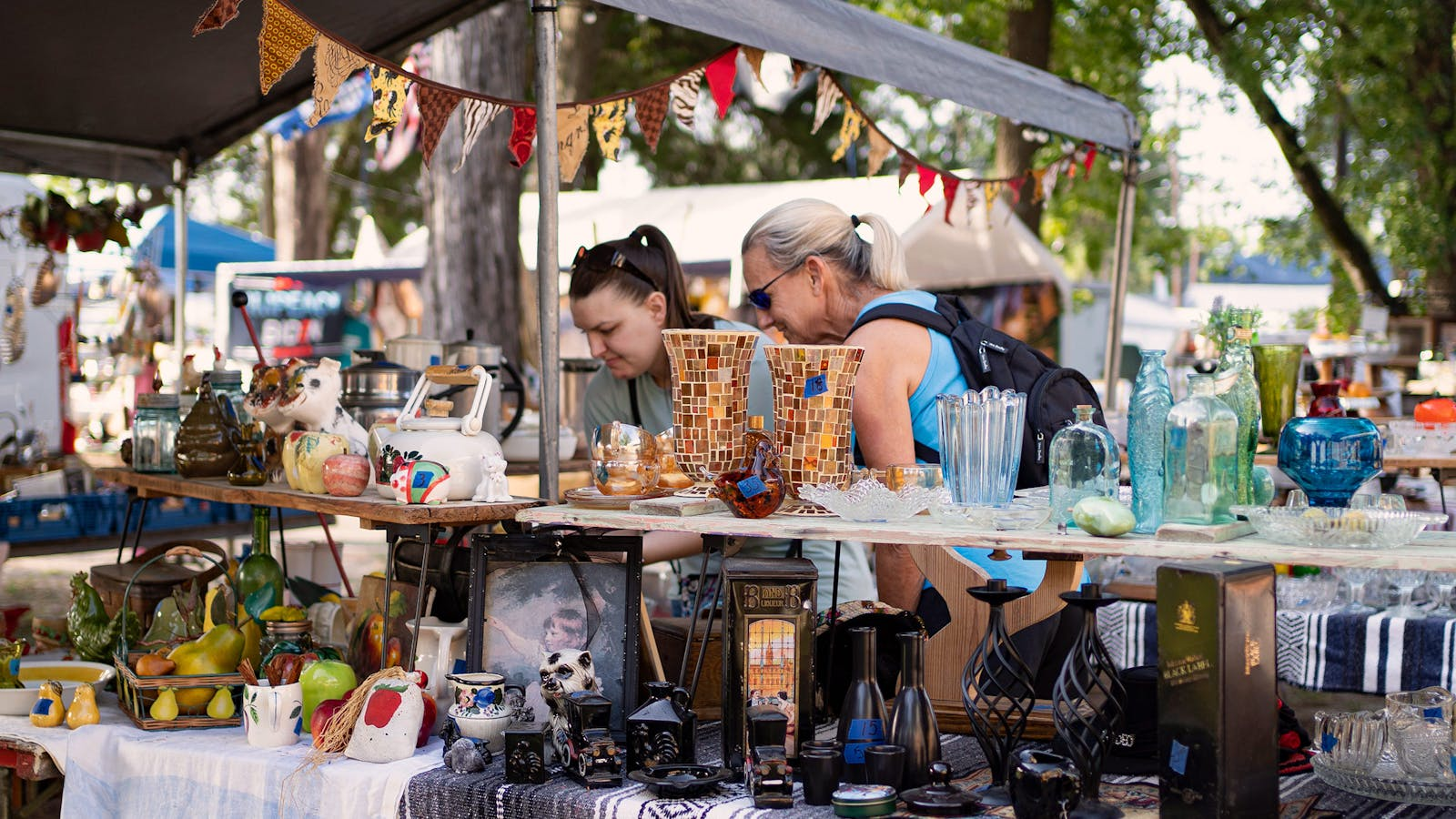
I’ve been walking flea markets long enough to know that there’s an entire language spoken there that doesn’t exist anywhere else. It’s not English exactly—it’s more like a dialect. A blend of hope, optimism, selective memory, and a healthy disregard for facts.
This little guide was born one Saturday morning while I was standing in a muddy field, coffee in one hand, cash in the other, listening to a guy explain—very confidently—why a chipped lamp with a cut cord was “an antique.”
It started innocently enough. I picked up the lamp, turned it over, and before I could even ask a question, the vendor jumped in.
“That’s an antique.”
Translation: it’s older than he is.
I nodded politely, the way you do when you don’t want to interrupt a performance. Flea market vendors are performers at heart. They don’t sell objects—they sell possibility. The possibility that this thing is worth more than it looks. The possibility that you’re about to steal it. The possibility that they almost kept it.
When I asked about the price, he paused, scratched his chin, and said, “I can do better on that.”
Translation: I priced it way too high and I know it.
That’s when I realized—this wasn’t about the lamp at all. It was about the language. Every phrase had a hidden meaning, and once you’ve been around long enough, you hear the translation instantly in your head.
“It’s a collectible.”
That one always makes me smile. Translation: it has no practical use whatsoever.
Then there’s the emotional angle. That comes out when an item really isn’t moving.
“That was my mom’s.”
Translation: I just picked that out of the trash.
If they really want to lay it on thick, you’ll hear, “My wife didn’t want to part with that.”
Translation: we have absolutely no use for it anymore.
At some point, I asked if the lamp worked. He leaned back, squinted at it like he’d never seen it before, and said, “I’m not sure if that works.”
Translation: it does not work at all.
Then came the closer. He handed it to me and said, “You might need to clean that.”
Translation: I used that as a toilet this morning.
That’s when I put the lamp down and wandered a few tables over, where another vendor smiled and said, “Make me an offer.”
Translation: I have no idea what this thing is worth.
That’s one of my favorites. It’s honest in its own way. At flea markets, confidence often drops as the day goes on, especially around noon when the coffee wears off and reality sets in.
“I just got that,” is another classic.
Translation: I’ve had it all season.
If you hear, “That’s an interesting piece,” what they’re really saying is, “Why did I ever buy that?”
And if they say, “I really like that piece,” just know that translates to, “That was a mistake.”
College gets dragged into this a lot too.
“My daughter used that in college.”
Translation: I picked that up on move-out day.
Then there’s my personal favorite, the phrase that means you’ve won.
“I don’t want to bring that home.”
Translation: I’ll take a dollar for it.
At that point, you’re basically doing them a favor.
You’ll also hear some creative accounting.
“You won’t believe what I paid for that.”
Translation: I got it for free.
“They sell for over $100 in the stores.”
Translation: the regular price is over $100.
“Selling for over $100 on eBay.”
Translation: they’re listed for $100 on eBay.
And of course…
“That’s new.”
Translation: it was used and put back in the box.
Sometimes they dig in.
“I’m firm on that price.”
Translation: I don’t really want to sell it.
And sometimes they play dumb.
“I know nothing about it.”
That can mean two very different things. Either they researched it and it’s worthless… or it’s hot, stolen, or counterfeit.
Same sentence. Very different outcomes.
By the time I made it back to my car that morning, empty-handed but entertained, I realized this guide wasn’t meant to make fun of flea market vendors. It’s actually a tribute.
Because flea markets aren’t really about the stuff. They’re about the stories, the theater, the language, and the dance between buyer and seller. If you take it too seriously, you miss the fun. If you listen closely, you learn a lot—not just about antiques, but about human nature.
And every once in a while, buried under all that translation, you actually find something good.
That’s what keeps me coming back.
Discover more from Beebop's
Subscribe to get the latest posts sent to your email.


This made me laugh. Mind you, you’ll be gutted when you see that lamp on Antiques Roadshow…
LikeLiked by 1 person