
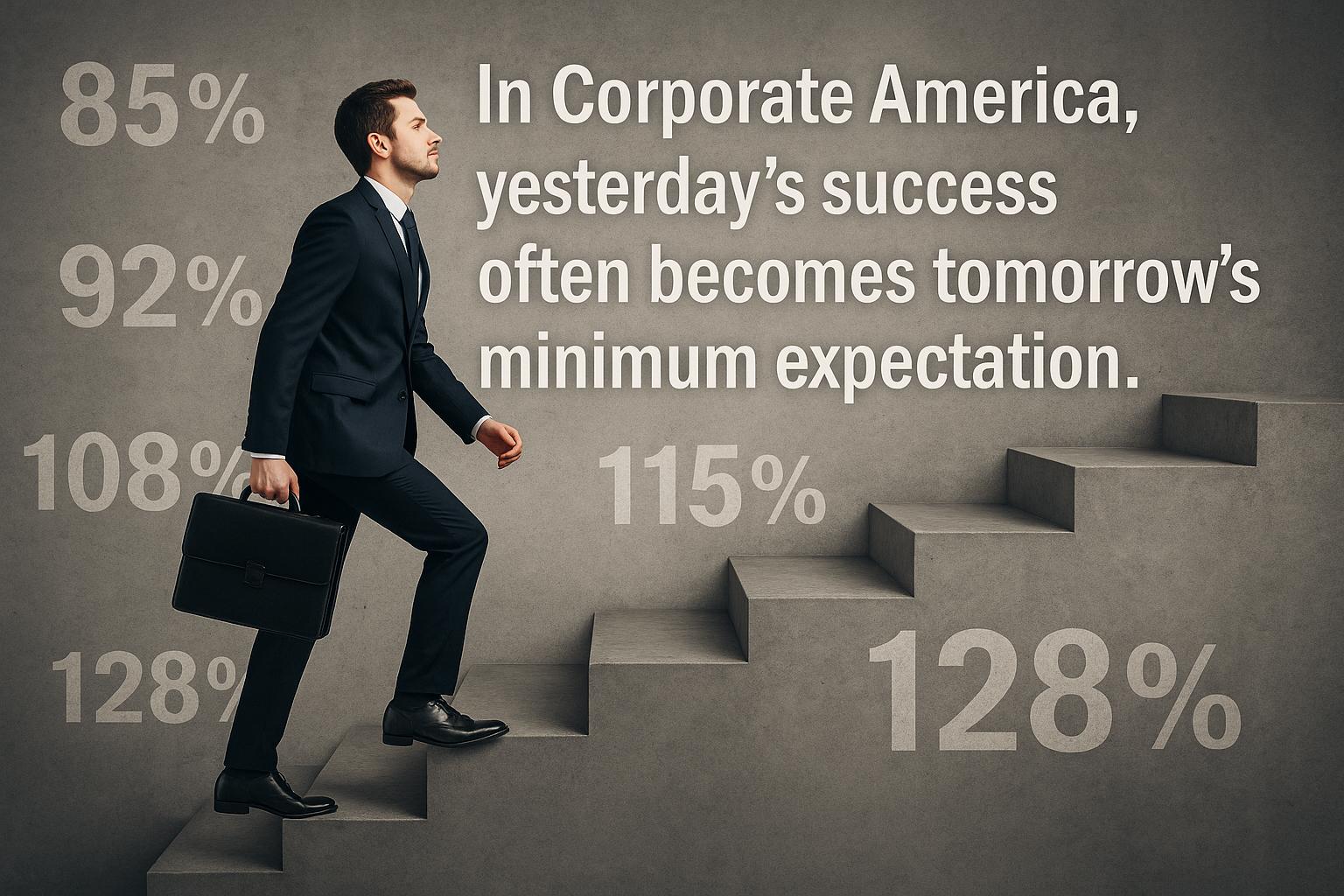

“In Corporate America, Yesterday’s Success Often Becomes Tomorrow’s Minimum Expectation”
I’ve spent my career chasing excellence, and for much of it, that pursuit was met with recognition, reward, and a sense of shared purpose. I started in retail with a large regional chain of stores, privately held and family-owned for over a century. This was the kind of company where employees were treated like family. If you exceeded your goals, you were rewarded. Praised. Promoted. Budgets were set based on realistic projections, and everyone started at the same point and finished at the same finish line. If you found ways to save the company money—whether in payroll or other expenses—your efforts were acknowledged, and they didn’t come back to haunt you the following year. Success here was tangible, celebrated, and sustainable.
Then, everything changed. That company closed its doors, and I was hired by a large, publicly traded national corporation. I approached my new job the same way I had approached my old one: I overachieved. I exceeded expectations in every measurable metric—sales, budgets, marketing, customer service. In the first few years, my results led the company. I thought I was following a proven formula for success.
I was wrong.
What I quickly learned is that corporate America—especially the publicly held variety—operates under a very different set of rules. Here, success is not just a reward; it’s a baseline expectation. Shareholder pressure, quarterly reports, and last year’s performance all combine to make the culture one where goalposts move constantly. My peers whispered warnings: “Be careful—those numbers are going to come back and bite you next year.” I soon realized what they meant: exceeding expectations one year often means those results are assumed as the minimum standard the next. These become you new goals.
I experienced this firsthand. Even though I led the company with the lowest payroll-to-sales percentage and the largest credit-card-to-sales performance—metrics no one else could touch—I received a “meets standard” rating in my review because I fell slightly short of a few goals. Achievements that would have earned praise in my previous company were now treated as average.
This experience taught me an invaluable lesson about managing expectations—not just the expectations others have of you, but the expectations you set for yourself. Being an overachiever isn’t just about doing the work; it’s about navigating the environment strategically. Excellence alone is not enough.
So how should overachievers navigate corporate America?
1. Understand the corporate context. Publicly traded companies are under constant scrutiny from investors and boards. What you achieve one year can create unrealistic pressure the next. Recognize the forces at play, and don’t assume the same behaviors that worked in a private or family-owned company will yield the same rewards.
2. Set your own benchmarks. Define success on your terms. Track personal standards and achievements that are independent of shifting corporate targets. This helps preserve your motivation and sense of accomplishment even when the company’s expectations escalate.
3. Build political awareness and relationships. Being the best at your metrics is critical—but in corporate culture, relationships and visibility matter just as much. Understand who influences decisions, who can advocate for your achievements, and how to navigate corporate dynamics strategically.
4. Document your wins—and the context. Keep records of your achievements, including any unique circumstances. Efficiencies you implement or improvements you make should be clearly noted; otherwise, they may be assumed as baseline expectations for the next year.
5. Communicate proactively. Don’t just meet expectations—help leadership understand how and why you achieved them. Clear communication ensures your contributions are recognized accurately and reduces the likelihood of being penalized when future goals are set.
6. Protect your mindset. Overachievers are wired to push, to excel, to achieve. When effort is no longer recognized as exceptional, it can feel demoralizing. Managing expectations is as much about mental resilience as it is about strategy.
Reflecting on my own journey, I’ve learned that overachievement in corporate America is both a gift and a challenge. Excellence opens doors—but unchecked, it can create pressure, unrealistic expectations, and frustration. The key is to be strategic, measured, and intentional in how you channel your energy.
Because at the end of the day, exceeding expectations is valuable—but exceeding them without managing the consequences is a path to burnout and disappointment.
Discover more from Beebop's
Subscribe to get the latest posts sent to your email.

 Beebop's