
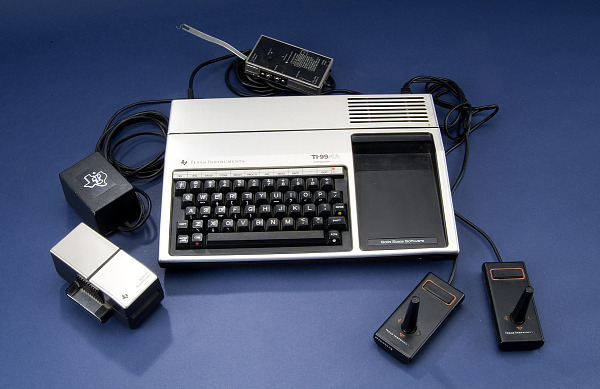


My first computer was the TI-99/4A, and calling it a computer still feels like Texas Instruments was grading on a curve.
It came into my life in the early 1980s, when home computers were just starting to sneak into living rooms and scare parents. Texas Instruments released the original TI-99/4 in 1979 and followed it with the improved 99/4A in 1981. That timing matters, because this machine wasn’t late to the party. It was actually one of the first to arrive.
The TI-99 series is often described as the first widely marketed 16-bit home computer, and that phrase needs a little translation if you didn’t live through it.
Back then, “8-bit” and “16-bit” described how much data the computer’s brain—the processor—could handle at once. An 8-bit computer could juggle very small chunks of information. A 16-bit machine could handle twice that, which was a big deal in 1981. It meant faster math, better graphics potential, and more complex programs. On paper, the TI-99/4A was more powerful than many of its competitors.
Now here’s the perspective shift.
A modern desktop computer today is typically 64-bit, which means it can process numbers so large and memory so vast that comparing it to a 16-bit machine is like comparing a tricycle to a freight train. My phone—my phone—is millions of times more powerful than that TI ever dreamed of being. The entire memory of the TI-99/4A would struggle to hold a single photo you casually text without thinking.
But in its day? That 16-bit label was impressive. It was future-leaning. It suggested Texas Instruments was thinking ahead.
Which made what happened next even stranger.
TI had everything going for it. They weren’t a startup in a garage. They made the chips. Calculators were already in every household. Semiconductors were their language. If anyone should have dominated the home computer revolution, it should have been them.
And yet… they didn’t.
The TI-99/4A plugged into the family television and greeted you with a blinking cursor that offered no guidance and no encouragement. There was no operating system in the modern sense. You turned it on and it basically said, “Okay, you’re in charge now.” No mouse. No windows. Just confidence—mostly misplaced.
Still, I was convinced I was living in the future. I even put it to noble use: teaching my young toddler daughter her letters and numbers. We’d sit on the living room floor, staring at the TV like it was Sesame Street—except instead of puppets, we had square pixels.
“A is for apple,” I’d say.
Up popped a giant blocky A, built out of pixels so large you could practically count them. The apple looked less like fruit and more like a red stop sign having an identity crisis. No sound. No animation. Just a letter on a screen. And somehow, that was enough. She was fascinated. Letters were appearing on the television because Dad pressed buttons. That felt like magic.
Behind the scenes, though, the TI-99/4A was quietly undermining itself.
Texas Instruments kept the system tightly closed. Third-party software was limited. Expansions were expensive. Memory upgrades required bulky add-ons. Disk drives took up half the desk and cost nearly as much as the computer itself.
Then came the fatal mistake: a brutal price war with Commodore in the early 1980s. TI slashed prices so aggressively that they reportedly sold machines at a loss. They won shelf space, flooded the market, and then shocked everyone—including their own customers—by abruptly exiting the home computer business in 1983.
They walked away. Just like that.
Texas Instruments wrote off hundreds of millions of dollars and returned to what they knew best: chips, calculators, and components that would quietly power everyone else’s success for decades.
Which feels oddly fitting.
That little beige box didn’t just teach my daughter that A was for apple. It taught me something too. Being early doesn’t mean you win. Being technically better doesn’t guarantee success. And sometimes the companies that help launch the future don’t stick around long enough to enjoy it.
Today we measure computers in gigahertz, gigabytes, and terabytes. Back then, we measured progress one pixelated letter at a time.
A was for apple.
B was for beige plastic.
And C was for a 16-bit computer that was smarter than its moment—but born into the wrong strategy.
Discover more from Beebop's
Subscribe to get the latest posts sent to your email.


I was working for TI at the time, and trained in-house technicians to get the ones coming off the manufacturing line to work, if they didn’t at first. The 16-bit processor was the 9900. It was originally designed for some of TI’s vision-aided test systems. The 8-bit processor that was designed for the home computer had serious problems at the foundry. The decision was made to use the 9900 and its companion video processor, hence the 99 in the final name. All the plug in modules with programs for games and word processing etc. were 8-bit, so a 16-8-bit multiplexing system had to be designed. With all that sophisticated hardware (for the time), when TI decided they had to compete on price with Radio Shack’s TRS-80 and the Commodore machine, it’s fate was basically sealed.
LikeLiked by 1 person
Thank you for your comment , very interesting
LikeLiked by 1 person