
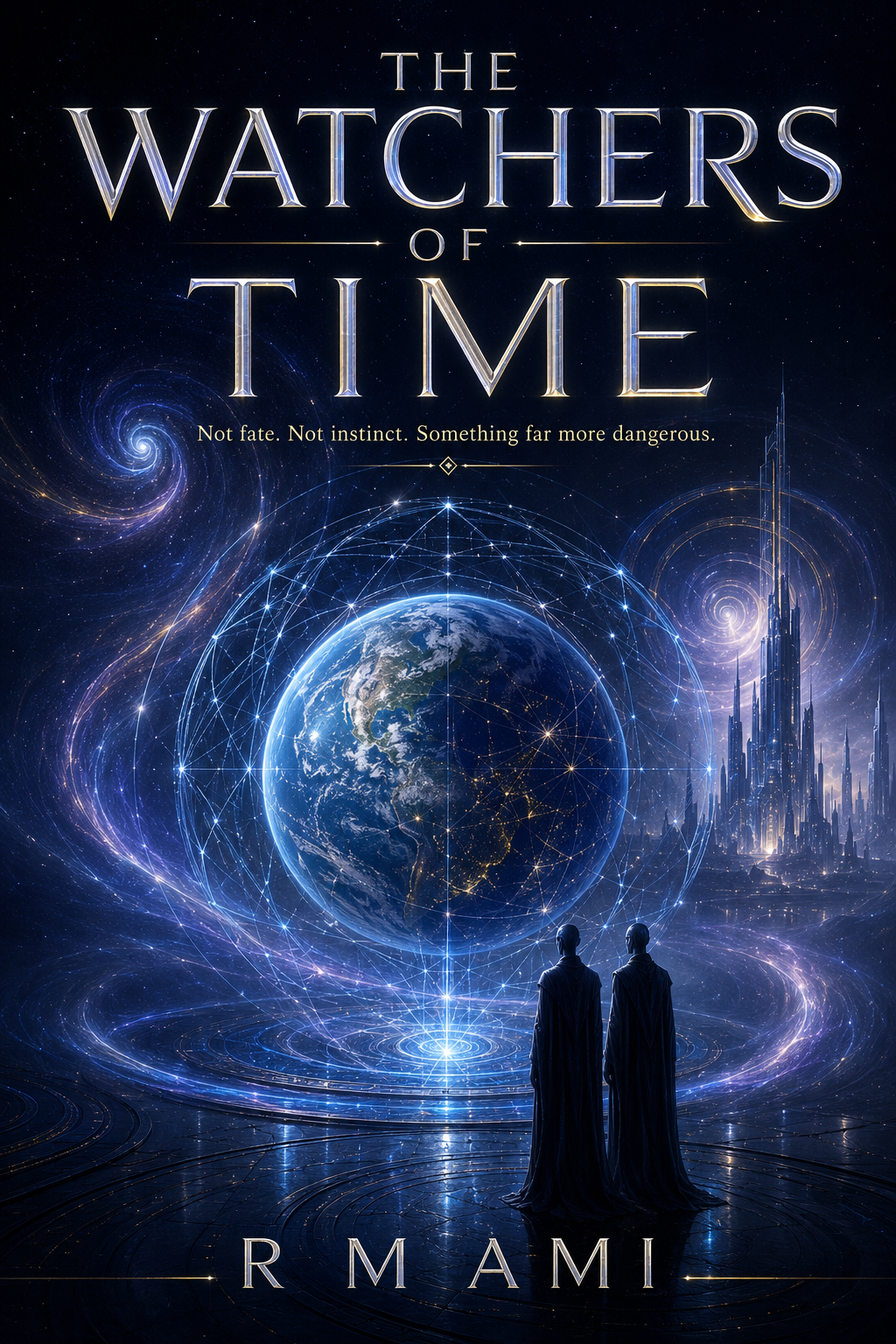


The book I never finished is actually one I was writing myself called The Watchers of Time.
The story begins roughly 350 billion years in the future, on a world called Elysiar. It is home to an ancient, highly advanced civilization that has existed for so long that nobody knows where it originally came from. Its people live in an almost perfect society, guided by science, artificial intelligence, and rules that have kept the civilization stable for ages.
A scientist named Seris develops something called the Temporal Lattice. It does not physically transport anyone through time. Instead, it allows the Watchers to look backward and observe distant worlds as they existed billions of years earlier.
One of those worlds is identified only as E-472.
At first, E-472 appears strangely peaceful. Its people survive, reproduce, cooperate, and follow their instincts, but they do not seem to possess true individuality. There is no real invention, rebellion, moral struggle, or conscious choice. Everything works almost too perfectly.
Then Seris witnesses something that should be impossible: a child hesitates.
It seems insignificant, but that hesitation represents the first genuine choice. At precisely the same moment, thousands of other beings across the planet begin showing compassion, imagination, restraint, curiosity, defiance, and creativity. Free will has suddenly appeared everywhere at once.
The Watchers call this event the Ripple.
The Temporal Lattice reacts as though something—or someone—has become aware that Seris is watching. A recurring symbol known as the Spiral begins appearing throughout the planet’s history. Ancient objects and buried technology suggest that advanced civilizations may have risen and disappeared many times before recorded history began.
Seris wants to understand what caused the Ripple, but the ruling Council becomes frightened. Veyra sees the discovery as a threat to everything their society believes. Chancellor Rhyos tries to contain it. An archivist named Lethan uncovers evidence that similar discoveries were made long ago and deliberately erased. Even Naelor, Seris’s mentor and the person she trusts most, eventually chooses the stability of their civilization over the truth.
The story then moves through different periods of E-472’s history. The same struggle continually returns: freedom against control, faith against certainty, and the desire to know the truth against the fear of what that truth might destroy. Ancient artifacts survive into the modern world, where Leena Varis and Clara Moretti begin piecing together evidence that human history is far older and stranger than anyone realizes.
Eventually, the Watchers make their greatest discovery.
E-472 is Earth.
But that is only the first part of the ending.
The Watchers are not aliens observing humanity from some distant world. Elysiar is Earth itself, hundreds of billions of years in the future. Its people are the unimaginably distant descendants of humanity. Their civilization has risen, collapsed, and rebuilt itself so many times that it has completely forgotten where it came from.
They believed they were studying another species when they were actually watching their own beginning.
They also discover that they were never gods and were never meant to control the past. They were witnesses. The presence within the Lattice was not trying to conquer them or even frighten them. It wanted to be seen—and perhaps to remind them that knowledge without humility can become just another form of blindness.
Naelor ultimately betrays Seris because he believes exposing the truth could destroy their civilization. Seris is arrested, and the memories connected to the discovery are erased. The official evidence is sealed away, allowing Elysiar to return to its comfortable certainty.
But the truth is not completely destroyed.
A small object containing part of the evidence escapes unnoticed in the hands of an ordinary worker. The story ends with the possibility that, someday, someone will discover it and begin asking the same questions again.
The final lesson of the Watchers is simple:
“We watch only to remember. We never watch in order to rule.”
I never finished turning the entire idea into a completed novel. I’m dyslexic, I never considered myself a writer, and the story became much larger and more complicated than I first imagined. But I could see that world. I could feel the characters, and I always knew how it would end.
That is why The Watchers of Time is still the unfinished book I think about.
Discover more from Beebop's
Subscribe to get the latest posts sent to your email.


